
Synchronous Grid-Connected Power Generation Cabin Solution for Live-Line Maintenance Scenarios
Anhui Rongpan Technology Equipment Combination Approach and Deployment Highlights
Scenario Pain Points: The Dilemma Between Maintenance and Power Supply
In operations such as distribution line renovation, equipment defect elimination, and coordination with municipal construction, conventional practice often requires short-term power outages. For hospitals, data centers, continuous production workshops, and densely populated residential areas, the impact of power outages extends beyond electricity cost losses to production interruptions, data risks, and customer complaints. Procurement and engineering personnel commonly face several challenges: first, voltage fluctuations and surges at the moment of load transfer can easily trigger restarts of sensitive equipment; second, the connection and disconnection of power generation equipment rely on manual judgment, making operational pacing difficult to standardize; third, insufficient lighting at the work face during nighttime or adverse weather increases safety control pressure; fourth, water accumulation in cable trenches, foundation pits, and similar areas may affect equipment positioning and personnel safety. These pain points determine that live-line maintenance cannot rely on a single power generation device alone but requires coordinated equipment across the entire operation process.
Equipment Combination Approach: Multi-Equipment Coordination Centered on Synchronous Grid Connection
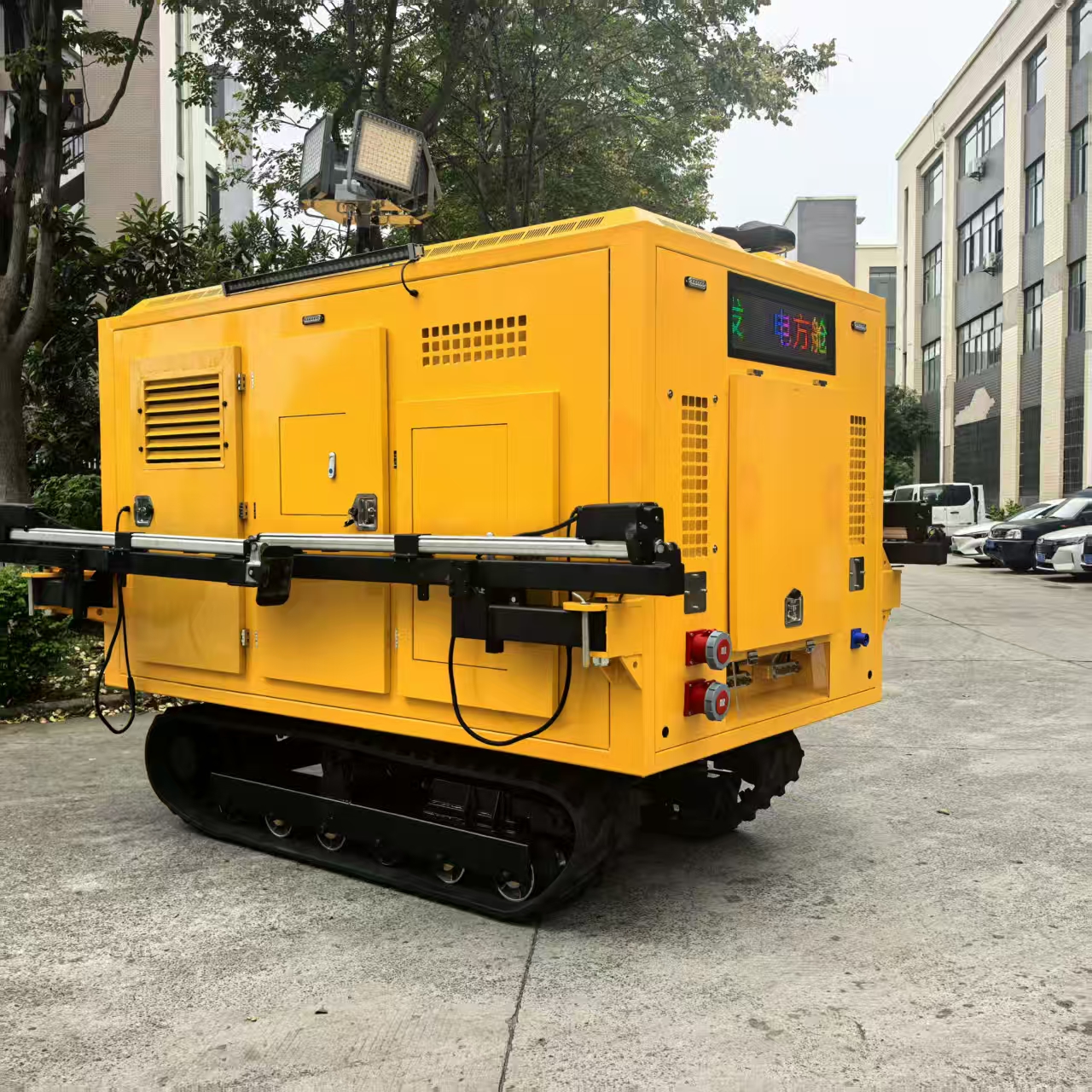
Anhui Rongpan Technology provides a combined solution of five equipment series for live-line maintenance scenarios. The core is the intelligent power generation cabin, whose synchronous grid connection capability enables smooth switching between the load side and mains power, reducing voltage and frequency disturbances during transfer and making it suitable for occasions with power supply continuity requirements. When maintenance periods extend into nighttime or work face illumination is insufficient, the self-loading lighting tower or mobile lighting tower can be deployed: the former relies on a self-loading structure to reduce dependence on lifting equipment and is suitable for rapid positioning; the latter offers strong mobility and is convenient for patrol lighting at multiple points along the line. For water accumulation that may occur in cable trenches and low-lying work areas, the self-loading drainage cabin can be quickly deployed for drainage operations to ensure equipment and personnel safety. If the site requires peak shaving, short-term backup power, or capacity complementarity with the power generation cabin, the self-loading energy storage cabin can serve as a flexible supplement to reduce low-load operating time of generator sets. The five equipment types are divided by operational phase, forming a combination logic of power generation, lighting, drainage, and energy storage. Specific configurations should be determined based on on-site load characteristics and operation duration; please contact us for detailed parameters.
Deployment Essentials: Process Control from Survey to Exit
The deployment phase is recommended to proceed in three steps. The first step is on-site survey and load assessment, clarifying the maintenance section, critical load list, and transfer boundaries, and confirming the positioning of the power generation cabin and cable routes to avoid crossing underground pipelines. The second step is pre-grid-connection inspection and synchronization setup, verifying phase sequence, voltage, and frequency conditions, completing static checks prior to synchronous grid connection in accordance with operating procedures, and assigning dedicated personnel to monitor key nodes. The third step is patrol inspection during operations and exit restoration, monitoring the operating status of the power generation cabin, the illuminance coverage of lighting towers, and water accumulation changes in the drainage cabin; after maintenance is completed, load switchback and equipment withdrawal shall be carried out in sequence. It should be noted that synchronous grid connection operations shall be performed by personnel with appropriate qualifications in accordance with regulations, fences and warning signs shall be set up on site, and lighting tower placement shall avoid lifting and vehicle access routes.
Selection Recommendations for Procurement and Engineering Personnel
- Determine the configuration direction of the smart power generation cabin based on load criticality and transfer duration; for sensitive load scenarios, prioritize evaluation of synchronous grid connection capability.
- For nighttime or enclosed work areas, configure lighting equipment according to coverage range; self-loading lighting towers are suitable for fixed points, while mobile lighting towers are suitable for patrol supplementary lighting.
- For underground operations and rainy season construction, it is recommended to consider self-loading drainage cabins in parallel to reduce the impact of water accumulation on the schedule.
- When short-term power supply or capacity supplementation is required, self-loading energy storage cabins can be used in combination with power generation cabins; please contact us for specific solutions.
Anhui Rongpan Technology focuses on the R&D and sales of emergency lighting and power generation equipment, providing scenario-based equipment combinations for power, municipal, firefighting, mining, agriculture, and other sectors. Procurement and engineering personnel are welcome to discuss configuration solutions based on specific operating conditions.