
Nighttime lighting deployment for mobile lighting towers: practical approaches from glare control to light spot coverage
An on-site lighting quality assessment framework for procurement and engineering personnel
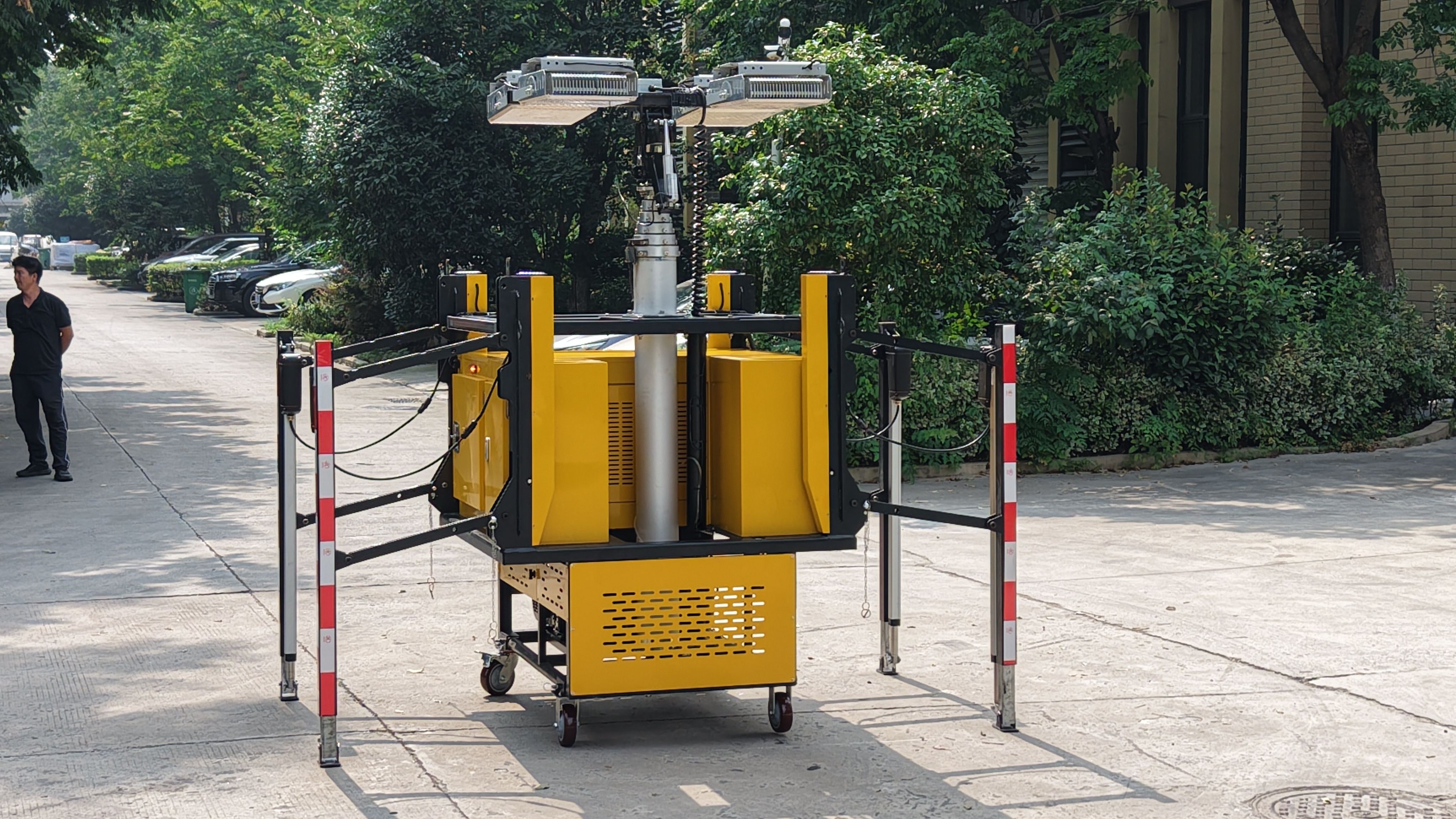
Why Nighttime Lighting Layout Cannot Be Based on Fixture Quantity Alone
Many procurement personnel, when evaluating mobile lighting towers, habitually ask first "how many lights are fitted and how many watts each," which is certainly basic information, but the visual quality of nighttime operations is not directly proportional to the number of fixtures. A common on-site problem is: there are plenty of lights, yet illumination across the work surface is uneven, shadows overlap, or operators facing the tower experience noticeable glare, which instead reduces visibility. The value of a mobile lighting tower lies in delivering light to where it is needed and creating a usable distribution across the work surface, rather than simply stacking brightness. Therefore, lighting layout should start from "what needs to be seen clearly on site" and then work backward to determine fixture mounting height, projection angle, and activation combinations.
Glare Control: An Overlooked On-Site Efficiency Variable
The impact of glare on nighttime operations is often underestimated. When the light-emitting surface of the tower directly enters the operator's field of view, the pupils constrict due to intense light stimulation, causing loss of detail in dark areas, and prolonged operation can easily lead to visual fatigue. Practical methods for controlling glare include: reasonably setting the elevation angle of the light head to avoid the main beam shining directly into areas where personnel are regularly stationed; using light-shielding accessories on the fixtures or adjusting the mounting orientation so that light is projected onto the work surface at a certain angle; and, where conditions permit, positioning the tower to the side-front of the work area rather than directly in front, reducing reverse incidence. For procurement personnel, attention can be paid to whether the tower has light head angle adjustment capability and whether mounting positions for light-shielding accessories are reserved; these structural details directly affect the flexibility of subsequent on-site lighting layout.
Light Spot Coverage and Work Surface Matching
Different work surfaces have clearly differing requirements for light spot shape. Power emergency repair may require concentration on a narrow, elongated area near towers, municipal construction often requires coverage of a wider road surface, and mining operations may require balancing slope areas and equipment operation zones. The light head of a mobile lighting tower typically supports a certain range of tilt and rotation. During procurement, confirm the ease of operation and locking reliability of the adjustment mechanism—whether on-site personnel can quickly adjust without additional tools is often more practically meaningful than the illumination distance listed in the specification sheet. In addition, when multiple lights are combined, overlapping light spot areas can easily form bright patches, while edge areas may be dim; during deployment, uniformity can be improved by staggering fixture projection angles and appropriately increasing mounting height. It should be noted that specific illumination range and uniformity indicators are closely related to fixture configuration and mounting height; please contact us for detailed parameters.
Deployment Position and Quick Assessment of On-Site Constraints
However well-conceived a lighting plan may be, it must be adapted to the specific site. Common constraints at night work sites include: whether the ground bearing capacity supports the stable footing of the light tower outriggers, whether surrounding obstructions interfere with the light path, whether the distance between the power access point and the light tower is within the allowable cable range, and whether vehicle traffic in the work area requires reserved safety clearance. A practical sequence of judgment is: first define the core area of the work surface, then select the light tower position so that its main beam covers the core area without directly illuminating permanently staffed points, then check outrigger support and cable routing, and finally fine-tune the lamp panel angle. For scenarios requiring frequent relocation, attention should also be paid to whether the light tower's deployment and retraction operations are convenient, so as to avoid lighting adjustments consuming excessive work time.
Several structural details worth attention during procurement evaluation
From a procurement perspective, although lighting quality depends on on-site operation, the structural design of the equipment itself determines the upper limit of operation. It is recommended to focus on: whether the lamp panel adjustment mechanism is smooth and has reliable locking; whether the luminaire mounting interface facilitates later replacement or addition/removal; whether the control method supports group lighting so that the illumination range can be flexibly adjusted according to work stages; and whether the overall wind resistance stability of the light tower in the deployed state matches local climate conditions. These details do not involve specific parameters, yet they directly affect the operability and repeatability of nighttime lighting. Anhui Rongpan Technology Co., Ltd., in the R&D and sales of mobile lighting towers, emphasizes structural adjustment convenience and on-site adaptability, serving multiple scenarios such as power, municipal, firefighting, mining, and agriculture. If you wish to discuss lighting configurations based on specific working conditions, you are welcome to contact us further.