
Delivery acceptance of mobile lighting towers: a checklist to verify before on-site power-on
From appearance to operation, break acceptance actions into executable steps
Why the acceptance stage is easily compressed
By the time the procurement process for mobile lighting towers reaches delivery, project milestones are often at their tightest. Equipment arrives on site, and signing, unloading, power-on testing, and lighting up are completed in one go, which looks highly efficient. But once acceptance actions are compressed, problems exposed during later use are difficult to attribute: was it transport impact, assembly negligence, or improper operation? For procurement and engineering personnel, acceptance is not a formality but the point at which equipment condition is fixed and subsequent maintenance responsibilities are clearly defined.
In product delivery for emergency lighting and power generation equipment, Anhui Rongpan Technology recommends breaking acceptance into several actions that can be checked off one by one, rather than vaguely "taking a look to see if it lights up." The checklist below does not involve specific parameters; it only covers verification logic. Please contact us for detailed configurations and parameters.
First Group of Actions: Appearance, Fastening, and Transport Marks
After the equipment arrives, do not rush to power it on. First walk around the vehicle and perform a static inspection. Focus on three types of marks:
- Structural component surfaces: Check the light mast, chassis, and support legs for obvious deformation, paint cracking, or impact dents, especially near transport tie-down points.
- Fastener condition: Check whether bolts, pins, and locks are complete, whether any are loose or missing, and whether folding or telescopic joints connect smoothly.
- Cables and connectors: Check power cables and control cables for sheath damage, whether connectors are fully seated, and whether cable retraction mechanisms jam.
If transport marks are found, record them on site and take photos to clarify whether they occurred during logistics or before leaving the factory, avoiding later disputes. This step takes little time but can prevent a considerable number of hidden problems.
Second Group of Actions: Lifting, Support, and Stability
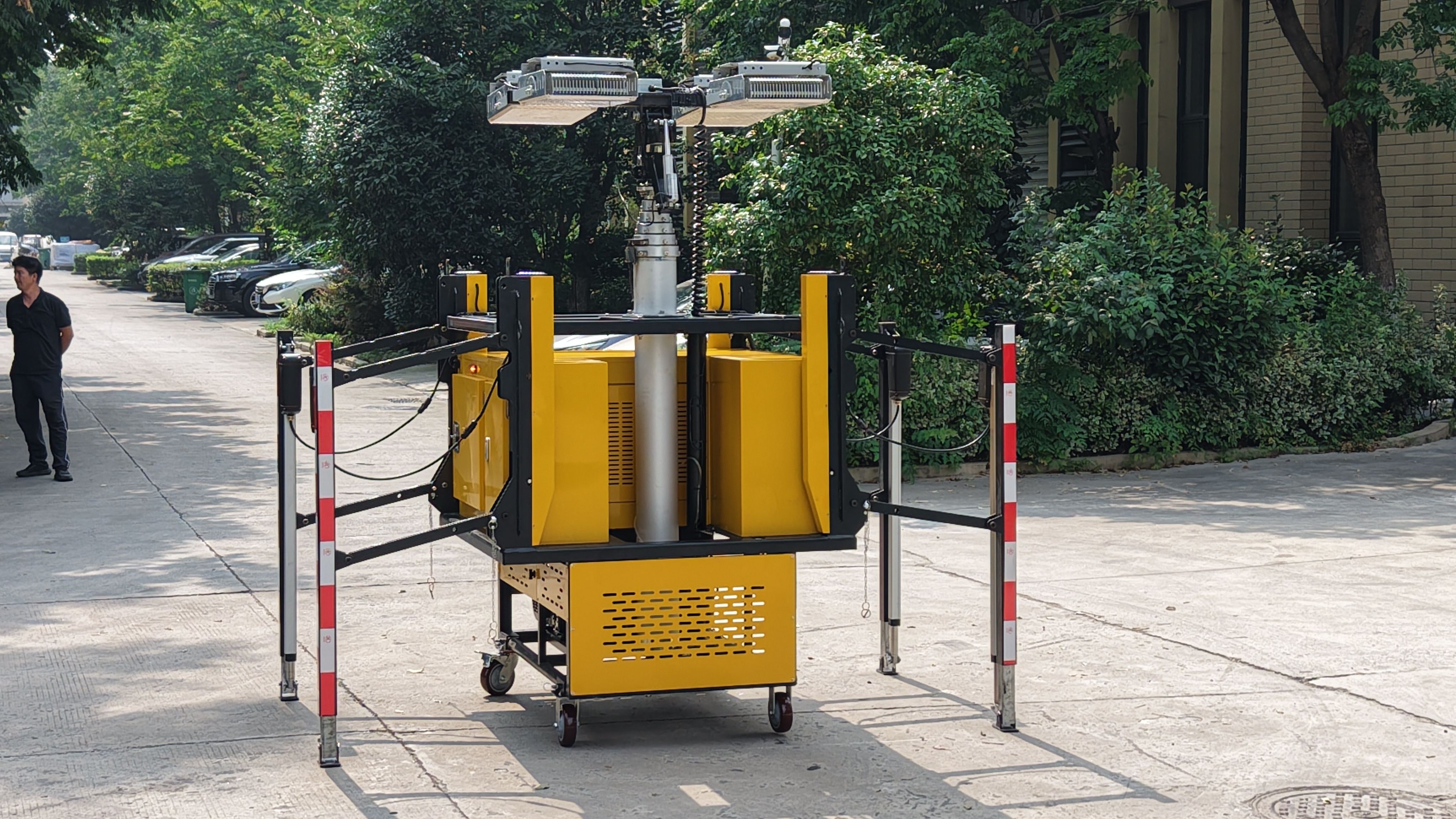
The core action of a mobile lighting tower is to "rise up and stay stable." Perform a complete lifting and support operation on flat, hardened ground:
- Check whether the support legs extend and level smoothly, and whether there is any play after locking;
- Check whether the lamp pole rises and lowers smoothly, without abnormal noise, jamming, or obvious swaying;
- After raising to the working position, observe overall stability under permissible wind conditions, and check whether the lamp panel orientation adjustment is flexible.
This set of actions is recommended to be performed by the personnel who will actually operate the equipment, rather than being done on their behalf only by procurement staff. Details such as operating feel, force required, and locking feedback can only be judged for ease of use by daily users. If the on-site ground conditions differ significantly from the expected use scenario, this should also be recorded as a reference for subsequent deployment.
Third Set of Actions: Power-On Test Lighting and Operating Procedure
The last step before power-on is to confirm that the power supply method matches the on-site power source. For the test lighting, it is recommended to run through the actual work sequence: startup, lamp group illumination, brightness or irradiation direction adjustment, shutdown, and reset. Key points to check include:
- Whether all lamp groups light up normally, and whether there is flickering or abnormal extinguishing;
- Whether the markings on the control panel or operating mechanism are clear, and whether the position feedback is definite;
- After continuous operation for a period of time, whether there is abnormal heating of the housing and cable connectors.
The test lighting does not need to pursue long-term full-load operation, but it should cover the complete chain of "on—adjust—off." If the equipment has a power generation or energy storage unit, the corresponding startup and shutdown checks should also be completed according to the accompanying instructions, and the specific operating sequence shall be subject to the delivery documents.
Fourth Set of Actions: Accompanying Documents and Handover Training
The equipment itself being free of problems does not mean the delivery is complete. During acceptance, the accompanying documents should also be checked for completeness, including the operating instructions, maintenance tips, packing list, etc., and it should be confirmed whether key spare parts and tools are in place. At the same time, arrange a brief operational handover so that the user team clearly understands the daily inspection items, the handling boundaries for common abnormalities, and which situations should be referred to the manufacturer rather than disassembled on their own.
Keep the acceptance checklist on file and store it together with the corresponding equipment number, so that subsequent O&M and lifecycle management have a starting point. For the purchaser, this record serves both as quality evidence and as a basis for internal handover. Anhui Rongpan Technology focuses on the R&D and sales of emergency lighting and power generation equipment, serving power, municipal, fire protection, mining, agriculture and other sectors. We welcome further discussion on acceptance key points for specific scenarios.